
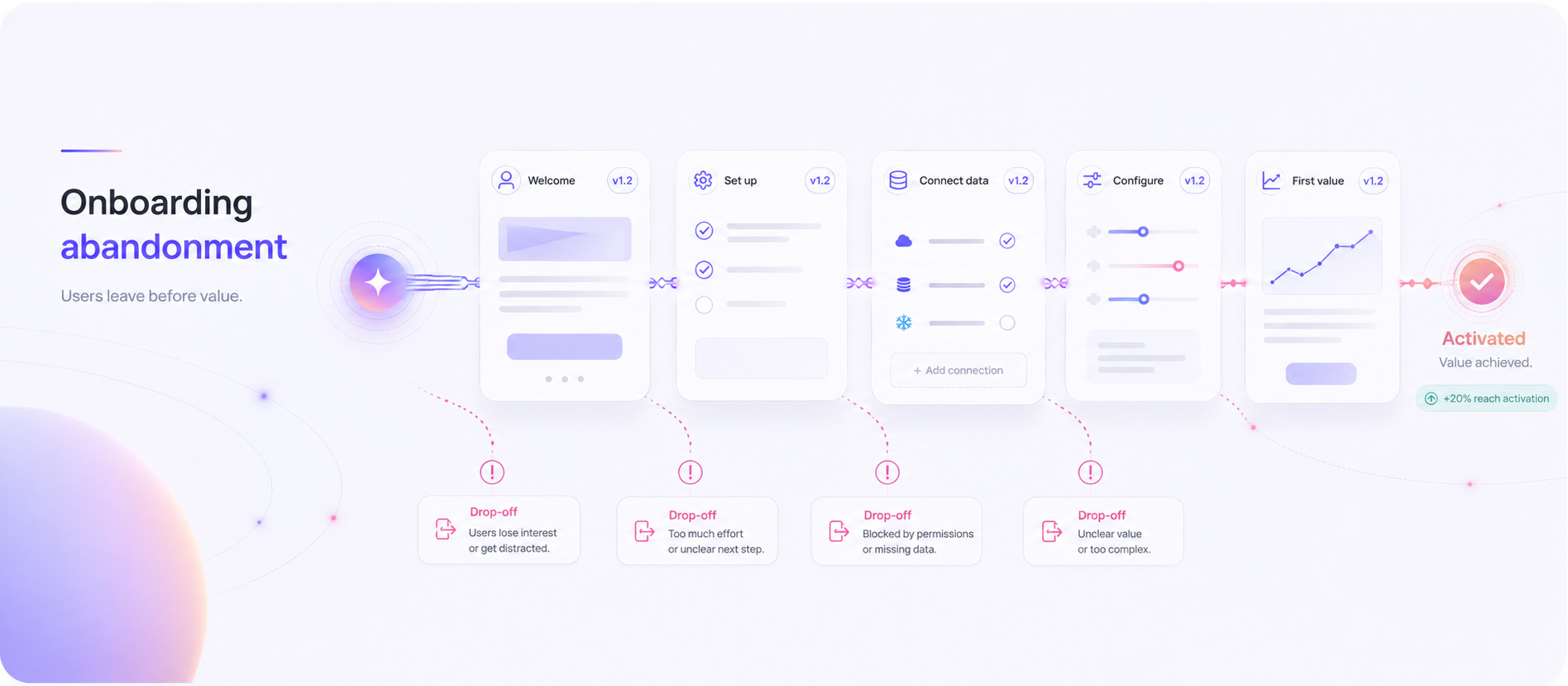
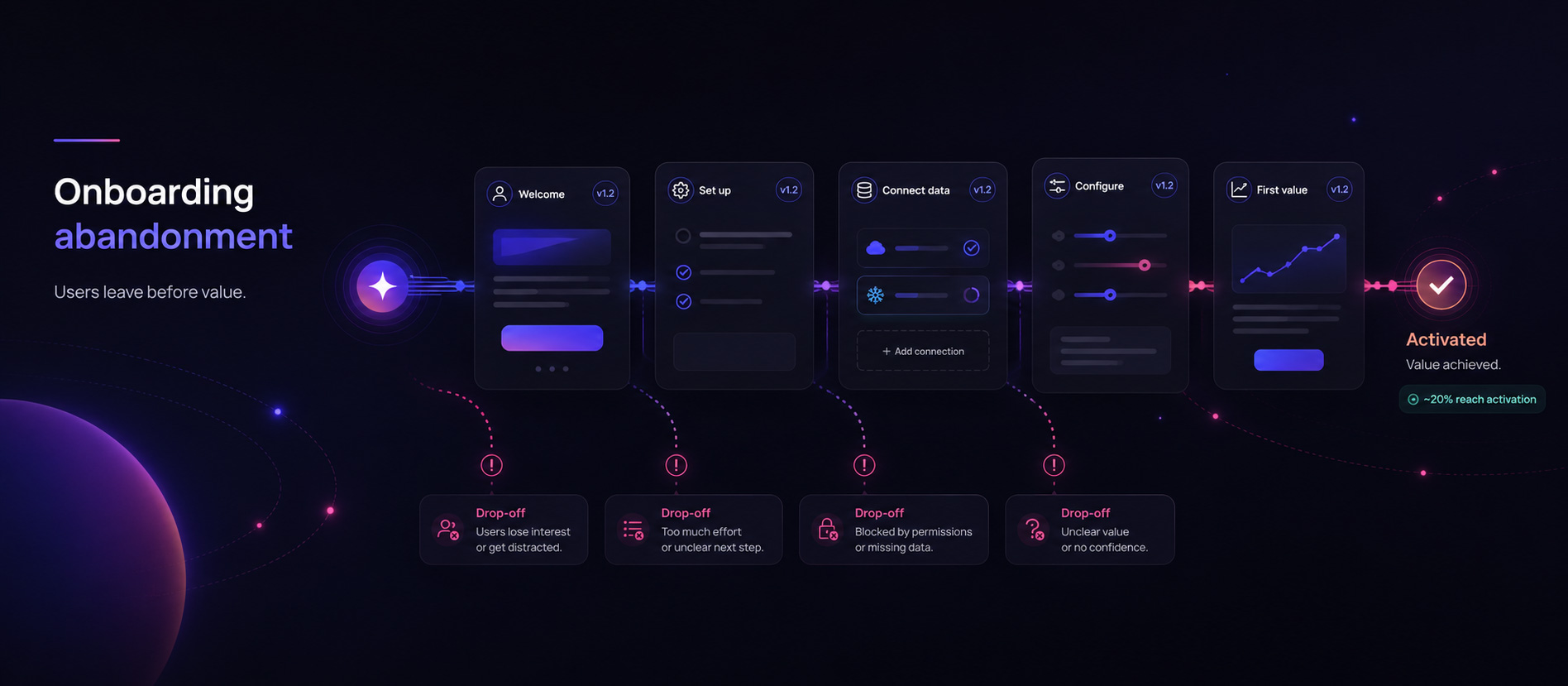
Problem
Onboarding abandonment:
why users leave before activation
Onboarding abandonment happens when a new user leaves before reaching the meaningful outcome the onboarding was designed to enable.
It is not the same as failing to complete every tooltip, tour, or checklist item. A user can skip part of a prescribed flow and still activate—or complete the entire flow without ever reaching value.
The practical task is to identify which failure stopped progress, then make the smallest credible change that helps users reach value.
What am I supposed to do next?
Is this required for setup, or can I do it later?
Why does this step need access to my data?
What will I be able to do after I finish this?
What onboarding abandonment means
The user leaves before the first meaningful outcome
The important boundary is activation—not whether every designed onboarding step was completed.
An activation event is a product-specific behaviour that shows a new user has experienced the core value of the product for the first time. Depending on the product, that might be publishing a first project, inviting a teammate, importing data, completing a meaningful workflow, or receiving a useful result.
A checklist completion or tour completion can support activation, but it is usually a weaker outcome by itself. Google’s HEART measurement framework recommends mapping product goals to observable signals and meaningful metrics, while the GOV.UK Service Standard advises teams to measure how well a service solves the problem it is intended to solve. For onboarding, that means measuring progress toward first value—not simply whether every piece of guidance was consumed.
That distinction matters because not every exit is a failure. A user might leave a tour to explore the product independently and still activate. Genuine abandonment is the failure to reach the intended outcome within a useful window.
How to measure onboarding abandonment
Measure progress toward value, not only flow completion
No single metric explains the problem. Use a small set of measures that describe whether users reach activation, how long it takes, and where progress stalls.
Activation rate
Step-level drop-off
Time to activation
Return and continuation
Activation-path feature use
Segmented outcomes
Google Analytics’ Funnel exploration guidance shows how to analyse the sequence of steps users take toward a task and where they complete or abandon that sequence. Pairing that behavioural view with a goal-to-signal framework such as HEART helps keep activation, time, progression, and quality measures tied to the outcome the product is meant to enable.
Onboarding diagnostic
Check the outcome, the path, and the user’s ability to continue
Do not assume the flow is too long or the copy is unclear until you know which type of failure occurred.
- Is the activation event a real first-value outcome rather than a convenient setup milestone?
- Is every required step necessary before activation, or can some configuration be deferred?
- Does each step explain what to do, why it matters, and what success looks like?
- Are prerequisites, permissions, technical requirements, and dependencies visible before the user reaches them?
- Do important decisions feel reversible, safe, and appropriately timed?
- Does the flow adapt to the user’s role, goal, experience, or use case?
- Are errors, slow responses, empty states, or failed integrations blocking progress?
- Do submitted questions or support messages concentrate around a particular step, term, or decision?
Why onboarding fails
Abandonment has several different causes
The best intervention depends on whether the user lacks value, understanding, confidence, ability, relevance, or a functioning path.
What it looks like in real questions
The user starts onboarding, then loses the mental model
Submitted questions provide direct evidence about what some users were still trying to understand when progress stalled.
- “Do I need to connect this first, or can I skip it?”
- “What does this step actually enable?”
- “Is this required for setup, or just recommended?”
- “If I choose the wrong option here, can I change it later?”
Different wording; a shared uncertainty about sequence, value, and risk.
How to diagnose onboarding abandonment
Move from the funnel leak to a specific failure hypothesis
Combine product data, technical evidence, and direct user input before changing the flow.
Define the activation outcome
Map the minimum path to activation
Instrument every meaningful transition
Find the highest-impact drop-off
Segment the affected users
Inspect behaviour and technical state
Review questions and direct feedback
Classify the failure mode
Choose the smallest credible intervention
Measure activation again
How to reduce onboarding abandonment
Match the intervention to the failure
There is no universal onboarding fix. Reduce the specific uncertainty, effort, risk, or technical barrier shown in the evidence.
When value is unclear
When the flow asks too much
When the next step is unclear
When choices feel risky
When users need different paths
When the flow technically fails
When sequence is the problem
When the product does not fit
The W3C guidance on clear process steps recommends making the current step, important choices, and the path through a process understandable. The GOV.UK Service Standard likewise advises teams to begin with the user’s problem rather than a preferred solution. Together, those principles support diagnosing the specific failure, reducing only the effort or uncertainty that blocks progress, and validating the result against the intended user outcome.
What not to optimise blindly
A smoother flow can still produce the wrong outcome
Protect the activation goal from proxy metrics that are easy to improve but weakly connected to value.
How Sol Helps supports the investigation
Add the questions users submit while they are still trying to activate
Sol Helps complements funnels, replay, and support data by preserving the original question, answer context, and page or path evidence behind recurring onboarding uncertainty.
What to do next
Audit one high-impact pre-activation drop-off
Start with a bounded problem and classify the failure before changing the complete onboarding experience.
Pick the highest-impact step before activation. Confirm the intended outcome, identify the users affected, inspect what happened immediately before they left, and collect the questions or feedback associated with that step. Then decide whether the failure is value, comprehension, confidence, ability, technical reliability, relevance, sequence, or product fit.